
By Mary Edwards, Sustainable Technology Student
Behind Katherine Harper Hall, a once-dormant small hydro project is flowing with new life thanks to the efforts of Sustainable Technology students at Appalachian State University. After months of maintenance and troubleshooting, the team successfully restored the system to working order, marking another step in App State’s commitment to renewable energy and hands-on learning.
The small hydro project, originally installed as a teaching and research tool, demonstrates how flowing water can generate clean electricity on a small scale. After Hurricane Helene severely damaged the system, leaving it inoperable, a team of students in Dr. Ram Poudel's Wind and Hydro Power Technology course took on the challenge of restoring and rebuilding it this semester.
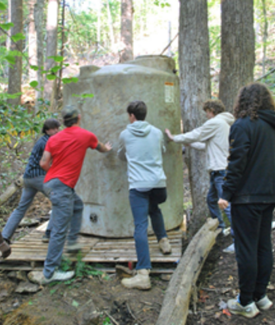
The repair process involved clearing the intake channel, constructing a new platform for the storage tank, and physically transporting and rolling the tank uphill into place. The team also resealed system connections and tested the electrical components to ensure safe and efficient energy production. This project not only restored a valuable teaching resource but also provided students with hands-on experience in system design, renewable technology maintenance problem-solving, and teamwork.
The revitalized hydro project will continue to serve as a living lab for future students, offering opportunities to monitor performance, collect data, and explore new ways to optimize small-scale renewable energy systems.
Looking ahead, the team aims to build on this momentum as Appalachian State prepares to join the 2026 Hydropower Collegiate Competition. The restored system will serve as a valuable training ground for students as they develop innovative solutions, gain technical experience, and represent App State on a national stage in the field of hydropower.
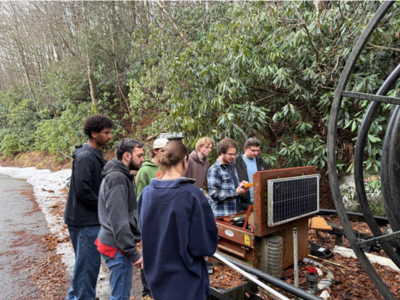
This project was completed by the following students in the Wind and Hydro Power Technology course:
Xander Anderson, Matthew Arango, John-Henry Barwick, Jackson Bilbro, Andrew Bir, Harper Bliss, Mary Edwards, Rigoberto Garcia Martinez, Dylan James, Haley Nyll, Lee Ongori, and Josh Willoughby. The team was led by faculty advisor Dr. Ram Poudel.
Testing The System Post Restoration: Spring 2026
By James Hiser and Samuel Sirianna, Sustainable Technology Student
After the restoration process was complete, Spring 2026 group of students in Dr. Ram’s Wind and Hydro Power Technology course tested the system. Some of the items that were tested to ensure proper function include: Flow testing at the generation side of the system, Pressure testing, along with power and voltage generation.
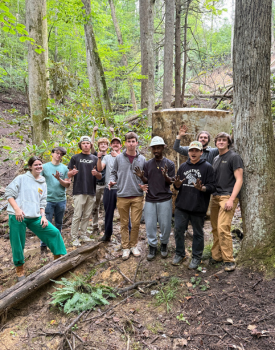
Before running the system, our battery was approximately at 10% charge. After confirming the initial check at the generation side was safe, students hiked to the top of the system where the penstock sits, inspecting the hoses along the way to make sure everything was connected correctly and undamaged. As students hiked to the top, others prepared for the flow test at the generation location. When the team at the top was ready, they opened the valve to allow water to flow from the penstock to the team below. At this point, we calculated the flow to be 66.7 gallons per minute, with a pressure reading of approximately 20 psi. While the hydropower system was running, the generator read 7.3 amps, giving a charge rating of 135 Watts. Compared to our measured output of 133, we are on track to operate at high efficiency.
At the end of the test, our batteries were able to be charged to roughly 90% battery life in roughly 30 minutes of run time. With an average charging voltage of 15 V, this was a great hands-on experience, allowing students to understand how hydro systems really work.

STBE logo

STBE logo